C H A P T E R 1 3
POWER TRAINS
CHAPTER LEARNING OBJECTIVES
Upon completion of this chapter, you should be able to do the following:
l Explain the mechanism of a power train.
In chapter 12 we saw how a combination of simple
machines and basic mechanisms was used in
constructing the internal combustion engine. In this
chapter we will learn how the power developed by the
engine is transmitted to perform the work required of it.
We will demonstrate the power train system used in
automobiles and most trucks in our discussion. As we
study the application of power trains, again look for the
simple machines that make up each of the machines or
mechanisms.
AUTOMOTIVE POWER TRAINS
In a vehicle, the mechanism that transmits the power
of the engine to the wheels or tracks and accessory
equipment is called the power train. In a simple
situation, a set of gears or a chain and sprocket could
perform this task, but automotive and construction
vehicles are not usually designed for such simple
operating conditions. They are designed to have great
pulling power, to move at high speeds, to travel in
reverse as well as forward, and to operate on rough
terrain as well as smooth roads. To meet these widely
varying demands, vehicles require several additional
accessory units.
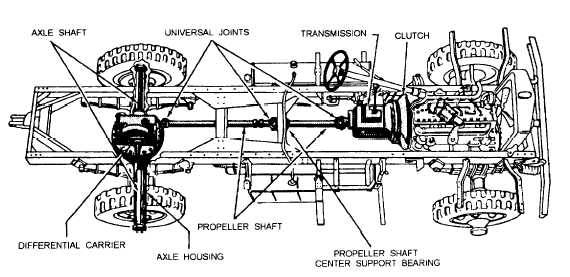
The power trains of automobiles and light trucks
driven by the two rear wheels consist of a clutch, a
transmission, a propeller shaft, a differential, and
driving axles (fig. 13-1).
Four- and six-wheel drive trucks have transfer cases
with additional drive shafts and live axles. Tractors,
shovels, cranes, and other heavy-duty vehicles that
move on tracks also have similar power trains. In
addition to assemblies that drive sprockets to move the
tracks, these vehicles also have auxiliary transmissions
Figure 13-1.-Type of power transmission.
13-1