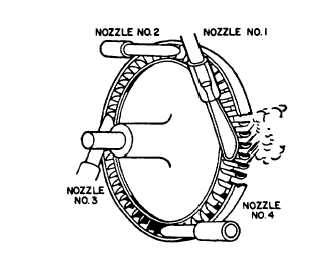
rapidly moving fluid against the blades and turn
the rotor (fig. 10-17).
REACTION TURBINE
The reaction turbine, as the name implies, is
turned by reactive force rather than by a direct
push or impulse. In reaction turbines, there are
no nozzles as such. Instead, the blades that project
radially from the periphery of the rotor are
formed and mounted so that the spaces between
the blades have, in cross section, the shape of
nozzles. Since these blades are mounted on the
revolving rotor, they are called moving blades.
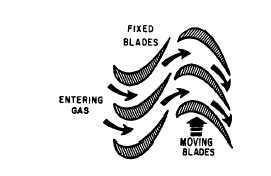
Fixed or stationary blades of the same shape
as the moving blades (fig. 10-18) are fastened to
the stator (casing) in which the rotor revolves. The
fixed blades guide the gas into the moving blade
system and, since they are also shaped and
mounted to provide nozzle-shaped spaces between
the blades, the freed blades also act as nozzles.
A reaction turbine is moved by three main
forces: (1) the reactive force produced on the
moving blades as the gas increases in velocity as
it expands through the nozzle-shaped spaces
between the blades; (2) the reactive force produced
on the moving blades when the gas changes
direction; and (3) the push or impulse of the gas
impinging upon the blades. Thus, as previously
noted, a reaction turbine is moved primarily by
reactive force but also to some extent by direct
impulse.
Impulse and reaction blades can be combined
to form an impulse-reaction turbine. This turbine
combines the rotational forces of the previously
described turbines; that is, it derives its rotation
from both the impulse of the gas striking the
turbine blades and the reactive force of the gas
changing direction.
Figure 10-17 .—Impulse turbine.
Figure 10-18.—Reaction turbine blading.
10-12