

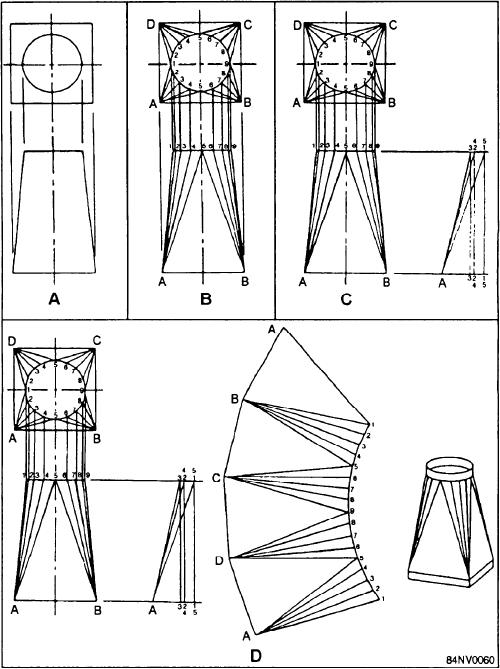
equal to the length of an element on the top view.
Figure 14-54 shows the following steps in the
Draw it with an altitude equal to the altitude of
triangulation of a warped transition piece joining a large
the corresponding element on the front view.
square pipe and a smaller round pipe:
The hypotenuse of the triangle is the true length
1. Draw the top and front orthographic views
of the element. In view C, the true-length
(view A).
diagram consists of only three right triangles.
2. Divide the circle in the top view into several
Since the piece is symmetrical, several elements
equal spaces and connect the division points
are the same length.
with the comers of the square (view B).
5. Draw the surface pattern by constructing one
3. Transfer the division points to the front view and
triangle at a time.
draw the elements. Some of the triangles curve
Figure 14-55 shows the following steps in
slightly, but they can be considered flat.
developing a rectangular transition piece that is not a
4. Now the true length of each of these elements
true pyramid because the extended lateral edges would
may be found. Draw a right triangle with a base
not meet at a common vertex. The best way to develop
Figure 14-54.--Development by triangulation of a transition piece.
14-34