

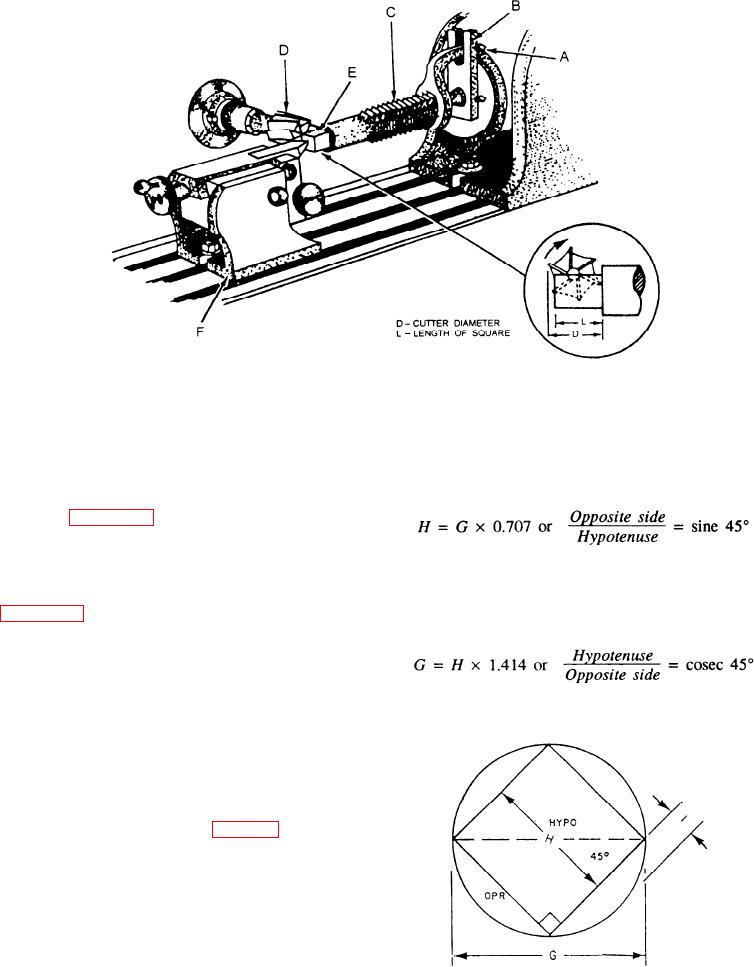
A. Lock screw for dog
D. End mill
B. Drive plate
E. Tap square
C. Tap
F. Footstock
Figure 7-63.--Milling a square using an end mill.
shown in figure 7-63, contains two lock screws. One
lock screw clamps the drive plate to the index center
and ensures that the drive plate moves with the index
spindle. The other lock screw clamps the tail of the
The diagonal of a square equals the distance
dog against the side of the drive plate slot, as shown in
across the flats times 1.414. This is expressed as
figure 7-63, A. This eliminates any movement of the
work during the machining operation.
Calculations
The following information will help you
determine the amount of material you must remove to
produce a square or a hexagon. You must calculate
the dimensions of the largest square or hexagon that
you can machine from a piece of stock.
The size of a square (H in fig. 7-64) is measured
across the flats. The largest square that you can cut
from a given size of round stock equals the diameter
of the stock in inches (which is also the diagonal of
the square) times 0.707. This may be expressed as:
Opposite side = Side of a square
Hypotenuse = Diagonal of square
Figure 7-64.--Diagram of a square.
45 = 90 bisected
7-36